Why Standing in the Shower Makes POTS Worse
The three-strike problem behind shower flares — heat, standing, and vasodilation — and how to redesign the routine so standing stops being the risk.
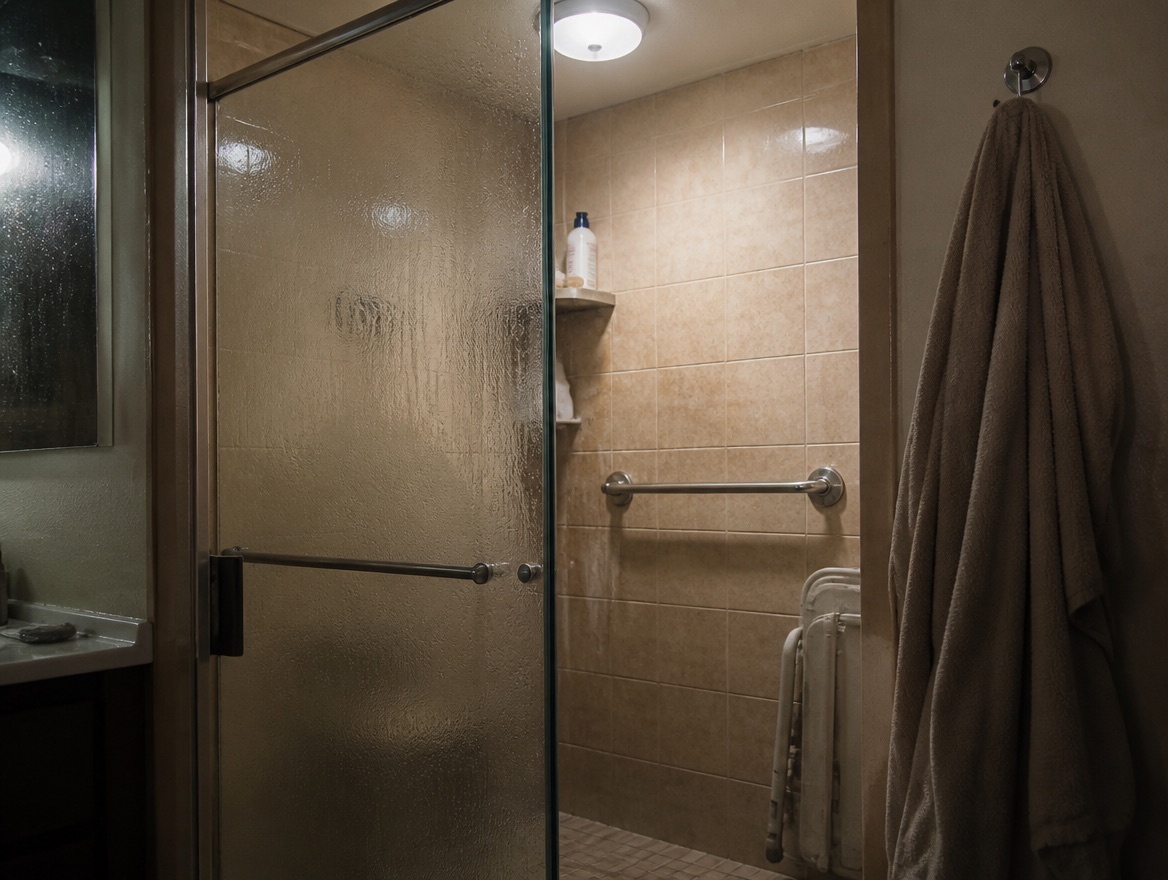
Most shower advice for POTS starts and ends at “sit down.” That’s genuinely useful, but it treats the shower as one problem when it’s actually three, stacked on top of each other. Standing is the piece that makes the other two unmanageable — which is why understanding standing specifically, and redesigning the routine around it, gets you further than a chair alone.
Three strikes, not one
Each of these is manageable on its own. Together, in a small hot room, they compound fast.
Strike one: heat. Hot water and steam heat your skin, and your body responds by widening blood vessels near the surface to shed that heat. That vasodilation is doing its job — but it also means more blood volume sitting in your skin and less available to fill your heart and reach your brain.
Strike two: standing still. Standing already asks your circulatory system to fight gravity, pulling blood down into your legs and pelvis instead of returning it to your chest. In POTS, that return is already inefficient. Add zero movement — no walking, no calf pump from taking steps — and blood has every opportunity to pool with nothing pushing it back up.
Strike three: arms overhead. Washing hair means raising your arms above your heart, which is a small thing that adds up. It briefly reduces the venous return working in your favor and raises the effort of the position you’re already in. It’s a minor factor by itself, but it tends to land at the exact moment — a few minutes into a hot shower — when the first two strikes are already peaking.
None of these alone reliably causes a flare for most people. Standing still in a cool room is fine. Brief heat exposure while moving is usually fine. It’s the overlap — heat plus stillness plus arms up, all inside a slippery enclosed space — that turns a routine task into a risk.
Why “just sit” sometimes isn’t the whole fix
A shower chair removes strike two, which is real progress. But some people still feel off in a hot, steamy, seated shower, because strikes one and three are untouched — the room is still heating your skin, and washing hair from a stool still means arms overhead. Sitting is necessary, but treating it as sufficient is where people get caught off guard mid-shower and assume the chair “isn’t working.”
The more complete fix redesigns the whole sequence, not just the standing part.
Redesigning the routine, step by step
Think of this as reordering tasks by how much they cost you, and doing the costly ones first, while you’re steadiest — not doing everything in whatever order is habitual.
- Before you turn the water on: Have fluids and your usual sodium on board well before you step in. Walking into a shower already low on volume means you’re starting the exercise with no reserve.
- Start cooler than feels indulgent. Begin the water cooler than your habit and let your body acclimate rather than opening hot and adjusting down. The first minute is when your reserve is highest, so don’t spend it accumulating heat.
- Do the arms-overhead task first, seated. Wash your hair early, seated, while you’re at your best — not at the end when heat has already accumulated and you’re more depleted.
- Save low-effort tasks for later in the shower. Rinsing, body wash, anything that doesn’t require raised arms, can come after — they cost less at the point where you have less reserve left.
- Keep the exposure short and ventilated. Crack a vent, prop the door slightly, or keep the shower brief enough that steam doesn’t fully saturate the air.
- Exit slowly, seated if needed. Sit to dry off rather than standing straight from a hot, humid room into a cooler one. That transition is its own small trigger, easy to overlook.
| Habit | Why the reorder helps |
|---|---|
| Fluids/sodium before, not during | You enter the highest-risk task with reserve already built |
| Cooler water at the start | Delays vasodilation instead of starting maximal |
| Hair washed first, seated | Arms-overhead task lands when you’re steadiest, not depleted |
| Low-effort tasks last | The easier steps absorb the point of lowest reserve |
| Seated, slow exit | Avoids stacking a temperature-transition trigger on top of the rest |
When to rethink the shower itself
For some people, no amount of reordering makes a standard hot shower workable, and that’s worth naming rather than pushing through. A lukewarm-to-cool shower routine, a bath with the water below body temperature, or sponge-bathing seated on particularly bad days are all reasonable adaptations, not failures. If you’re in a flare, newly diagnosed, pregnant, or recovering from a viral illness, your tolerance for heat and standing may be temporarily much lower than baseline — that’s a conversation for your clinician, not something to guess your way through.
If you’re fainting, not just feeling faint, in the shower — that’s a safety issue independent of any routine fix, and it belongs in a conversation with your clinician about grab bars, a second person nearby, or whether the shower needs a more fundamental redesign than sequencing.
The bottom line
Standing is what turns two survivable factors — heat and arms overhead — into a flare, because it removes the one thing helping your circulation fight gravity. A chair addresses that piece directly, but the fuller fix reorders the whole routine: hydrate first, start cooler, do the arms-overhead task early while you’re steadiest, and exit slowly. If a redesigned routine still isn’t enough, that’s information for your clinician, not a reason to tough it out.