
Recumbent Bike for POTS: A 12-Week Ramp That Respects the Floor
A graded recumbent-bike conditioning plan modeled on CHOP-style protocols, with weekly structure, heart-rate cues, and clear permission to back off.
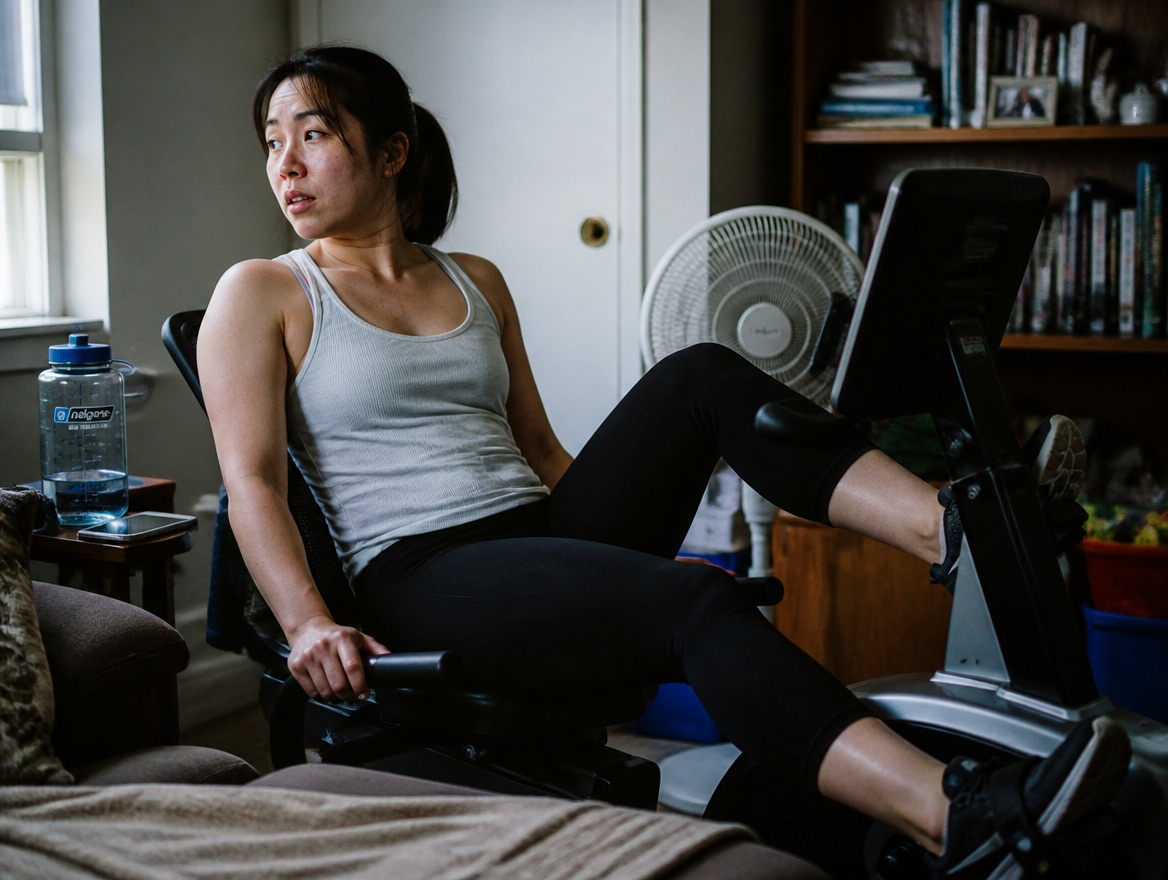
The recumbent bike gets recommended to people with POTS so often that it’s almost a cliché, and for once the cliché is earned. You’re semi-reclined, your legs are out in front of you instead of hanging down, and gravity has far less chance to pool blood in your lower half than it does when you’re upright. That means you can build some conditioning without immediately paying for it with a heart rate that shoots past 140 the moment you start.
But “get on a recumbent bike” is not a plan, and the gap between that advice and an actual week-by-week structure is where a lot of us stall out — or overdo it on a good day and lose the next week. What follows is a slow, graded ramp modeled on the kind of recumbent exercise protocols developed for autonomic dysfunction (the CHOP-style progressions are the best known). Treat it as a sketch to bring to your own care team, not a prescription. I’ve lived this ramp more than once, and the version that works is always slower than the version I want.
The principle: respect the floor
“The floor” is the baseline you can hit on a bad week without a flare. The whole point of a graded ramp is to raise that floor a little at a time, never to chase a ceiling. Two rules hold the plan together:
- Progress by time before intensity. You earn more minutes first. Resistance and effort come later, and only once the current duration feels genuinely easy.
- A bad week means you hold or step back, not push through. Repeating a week — or dropping to the previous one — is part of the plan, not a failure of it. POTS weeks are uneven, and the ramp has to bend.
Heart-rate cues, not heroics
Most graded programs anchor to heart rate rather than to how hard you feel like working, because “how you feel” lies on both good and bad days. Many clinicians set a rough working ceiling in the range of 70–80% of an age-predicted maximum, but the specific number should come from your own doctor, especially if you take a beta blocker or another rate-limiting medication that changes what your heart rate even means.
The cue I actually use minute to minute is simpler: I should be able to talk in short sentences. If I can’t get a sentence out, I’m over the line and I ease off. If my heart rate climbs and stays climbing even after I lower the resistance, that’s the session’s signal to stop — not a wall to break through.
The 12-week shape
The ramp below moves through three phases: base (find a tolerable duration), build (extend it), and bridge (add gentle intensity and start hinting toward upright work). Sessions are 3 times a week with a full rest day between.
| Weeks | Phase | Rough session | Focus |
|---|---|---|---|
| 1–2 | Base | 5–10 min, minimal resistance | Just show up; keep HR civil, finish feeling you could do more |
| 3–4 | Base | 10–15 min, minimal resistance | Extend time only; still no meaningful resistance |
| 5–6 | Build | 15–20 min, a touch of resistance | Add small resistance once 15 min feels easy |
| 7–8 | Build | 20–25 min, light resistance | Steady state; this is where consistency compounds |
| 9–10 | Bridge | 25–30 min, light–moderate resistance | Optional 1-min gentle intervals if steady state is comfortable |
| 11–12 | Bridge | 30 min, moderate resistance | Hold here a while; discuss adding brief upright work with your clinician |
A few things the table can’t say. The minutes are targets, not requirements — if week 5 knocks you flat, you go back to week 4 and stay there until it’s boring. Nobody is behind schedule; there is no schedule. And 30 minutes three times a week at moderate resistance is a genuinely strong place to be with POTS. Plenty of people spend months, not two weeks, in each phase, and that’s the plan working, not lagging.
Around every session
What you do before and after the bike matters as much as the pedaling, because you’re asking a system with a blood-volume problem to work harder.
- Before: Be well-hydrated with sodium already on board. Starting a session depleted is how a manageable ride turns into a flare.
- During: Keep fluids in reach and sip throughout. Keep the room cool — heat plus exertion is a bad combination for POTS, and a fan aimed at you helps more than it should.
- After: Rehydrate, and don’t stack a demanding standing task straight onto a session. Give yourself a beat lying down or seated before you go vertical.
- Between: Build in real recovery. The rest day is doing work too.
When to stop and reassess
Ease off or end the session if you get pre-faint lightheadedness, chest pain, a heart rate that won’t settle when you reduce effort, or symptoms that are clearly worse than your normal exertion baseline. And loop in your clinician before you start if you have any cardiac history, if your POTS is newly diagnosed or poorly controlled, or if you’re on medication that affects heart rate or blood pressure. A physical therapist familiar with dysautonomia can calibrate this ramp to you far better than any table can.
The bottom line
A recumbent bike lets you build fitness with POTS because the reclined position keeps gravity from doing its worst. The ramp that works is slow: earn minutes before intensity, anchor effort to heart rate and the talk test, and treat a bad week as permission to hold or step back rather than push. Twelve weeks is the shape, not the deadline — and getting to a steady 30 minutes, at whatever pace your body allows, is a real win. Build it with your care team, and let the floor rise on its own time.