Compression Socks for POTS: How Many mmHg, and Where on the Leg
A practical guide to choosing compression gear for POTS — pressure grades, knee-high vs thigh-high vs waist-high, and the trade-off between comfort and venous return.
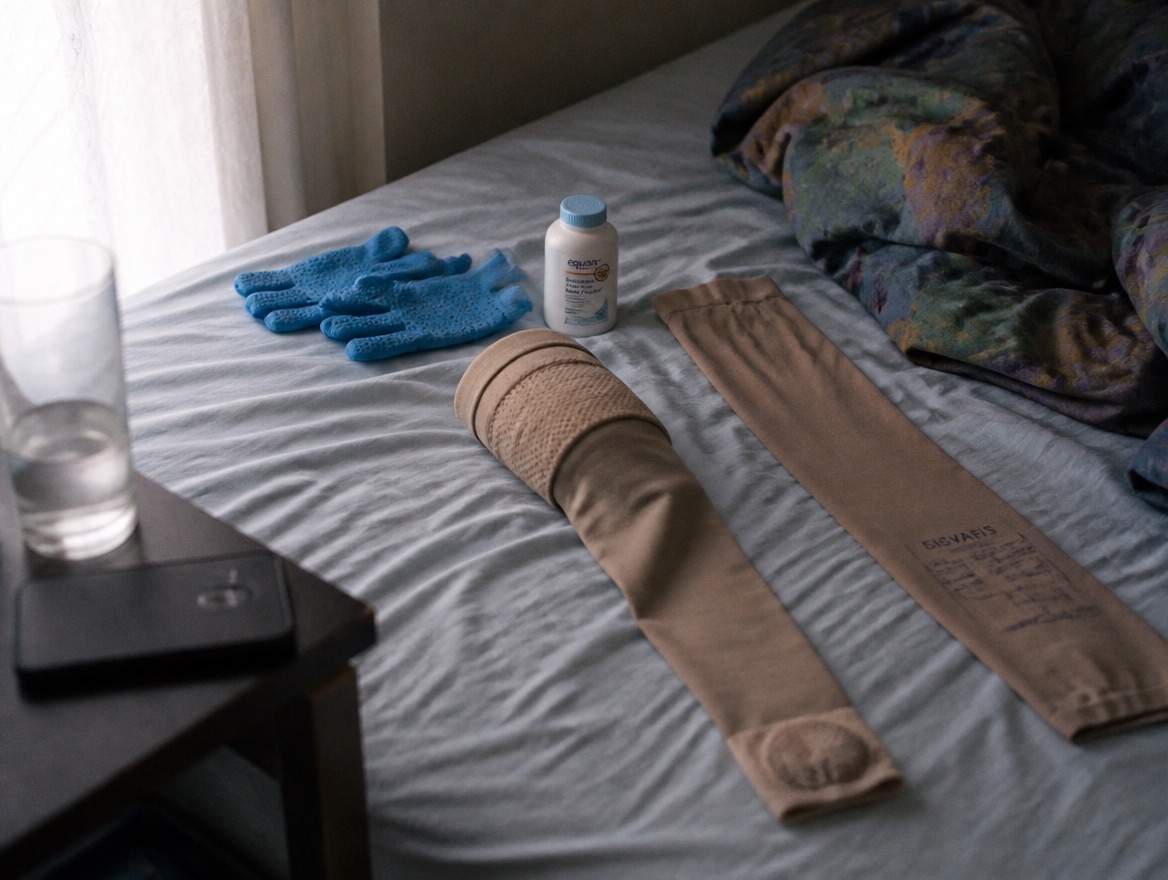
Compression for POTS sits somewhere between a medical device and a daily routine. The premise is straightforward: gravity pulls blood toward your legs and abdomen when you stand, and graduated compression pushes some of it back. When it works, you feel it on the morning errands you can finish and the afternoon you do not lose to lightheadedness. When it does not work, it is almost always because the pressure was too low, the garment was the wrong shape, or it was only being worn for the easy part of the day.
This is a field guide to the two questions readers ask most: how many millimeters of mercury do I actually need, and where on the leg does it need to cover. Like everything in this manual, it is general information, not medical advice. The right compression plan for you — including whether it fits with any other conditions, medications, or vascular history — is something to settle with your clinician.
What “mmHg” actually means
The number printed on the label — for example 15–20 mmHg — is the pressure the garment exerts at the ankle, where it is meant to be tightest. Graduated compression then steps the pressure down as it moves up the leg, so blood and lymph are encouraged to move toward the heart rather than pooling in the calves and thighs.
The common ranges you will see in catalogs and pharmacies are:
| Grade | Pressure | What it is typically used for |
|---|---|---|
| Mild | 8–15 mmHg | Travel, light swelling, “energy” socks |
| Moderate | 15–20 mmHg | Everyday support, mild orthostatic symptoms |
| Firm (medical) | 20–30 mmHg | The range most often discussed for POTS |
| Extra firm | 30–40 mmHg | Severe venous disease, lymphedema |
For POTS, the range most clinicians and the published patient guidance point toward is 20–30 mmHg. The 8–15 mmHg “travel socks” sold at airport kiosks are not really in the same category — they are too gentle to meaningfully change the standing response in most people with autonomic dysfunction. If your reaction to your first pair was I did not notice anything, the dose was probably the issue, not the principle.
Where on the leg matters more than people expect
Knee-high socks are the default because they are easy to put on and look like ordinary socks. They are also the least effective shape for POTS, because the pooling that drives autonomic symptoms happens not only in the calves but in the thighs and the splanchnic vasculature — the abdominal vessels that hold a remarkable share of total blood volume.
A useful way to think about it: the higher the garment, the more of the gravity problem it is addressing.
- Knee-high (20–30 mmHg). Targets calf pooling. Reasonable as a starting point and often what is tried first because the put-on tax is low.
- Thigh-high (20–30 mmHg). Adds coverage over the larger leg vessels. Many readers report a meaningful step up from knee-highs, especially on heat days and long-standing days.
- Waist-high tights or abdominal binder + thigh-highs (20–30 mmHg). Adds compression over the abdomen, which is where the published POTS literature suggests the largest single improvement in orthostatic tolerance tends to come from. The trade-off is comfort and the time it takes to get dressed.
A practical pattern many readers settle on: thigh-highs as the everyday default, abdominal compression added for high-symptom days, longer standing, travel, or heat — and the rule that any compression worn for only part of a day is competing with a body that has already pooled.
Putting them on, taking them off
A 20–30 mmHg garment is, deliberately, harder to put on than a regular sock. That is not a defect — it is the dose. A few things that help, and that wear out fewer pairs of gloves and patience:
- Put them on first thing, before gravity has done its morning work. Compression is much harder to apply on a leg that has already pooled. Many readers keep their pair on the nightstand.
- Smooth, do not yank. Walk the fabric up the leg in small even rolls, like rolling on a stocking, rather than pulling at the top. Yanking thins the fabric unevenly and is how seams blow.
- Rubber dish gloves or grippy “donning gloves” give you grip on the fabric without snagging it. A small bottle of unscented talc helps in summer.
- Take a break in the middle of the day if you need to, but understand the trade-off. Re-applying them after several hours of pooling is genuinely harder than the morning put-on.
- Replace them when they stop feeling like work. Compression fabric loses its elasticity. A pair that goes on too easily is no longer dosing you. Most manufacturers suggest a 3–6 month replacement cycle for daily-worn 20–30 mmHg gear.
When compression is the wrong tool, or needs supervision
A few situations are reasons to talk to your clinician before adding compression rather than ordering a pair online:
- Peripheral arterial disease, severe diabetic neuropathy, or any history of poor leg circulation. Firm compression can be harmful if arterial flow is already compromised.
- Skin conditions, open wounds, or recent vascular procedures. These need a clinician’s call on fit and timing.
- A new asymmetric leg swelling, a hot calf, or sudden shortness of breath. These can be signs of a clot and are not problems compression solves — they are reasons to seek urgent care.
If you have any of the above, or if you are not sure, ask. Compression for POTS is generally well tolerated, but “generally” is doing some work in that sentence.
A starting plan
If you are new to compression and your clinician has not specified a starting point, a reasonable place to begin is a single pair of 20–30 mmHg thigh-highs, measured to your leg (most reputable brands publish a sizing chart with measurements at the ankle, calf, and thigh). Wear them from the moment you stand up, all day, for two weeks. Note whether the morning floor is steadier, whether the afternoon drop is smaller, and whether you can stand in line a little longer without symptoms climbing.
If the answer is partially, the next step is usually to add some form of abdominal compression — a waist-high tight, an abdominal binder worn over the tights, or a maternity-style band repurposed for the same job. If the answer is not at all, that is worth raising with your clinician before going higher in pressure, because the issue may be sizing or condition-related rather than dose.
The bottom line
Compression for POTS works to the extent that it is dosed correctly and worn correctly. For most readers that means 20–30 mmHg, covering more of the leg than knee-highs do — thigh-highs as a default, and adding abdominal compression for the days that need it. The mild airport-kiosk socks are a different product solving a different problem. Put them on before you stand up, take them off only when you can lie down, and replace them when they stop being a small daily effort to get on. The right pair feels like a quiet hand keeping blood where it is supposed to be — and the rest of your routines do not have to work quite as hard.