Coffee and POTS: The Case For, the Case Against, and the Timing Question
Caffeine both tightens blood vessels and speeds the heart — the split effect behind coffee's mixed reputation in POTS, and how some patients time it strategically.
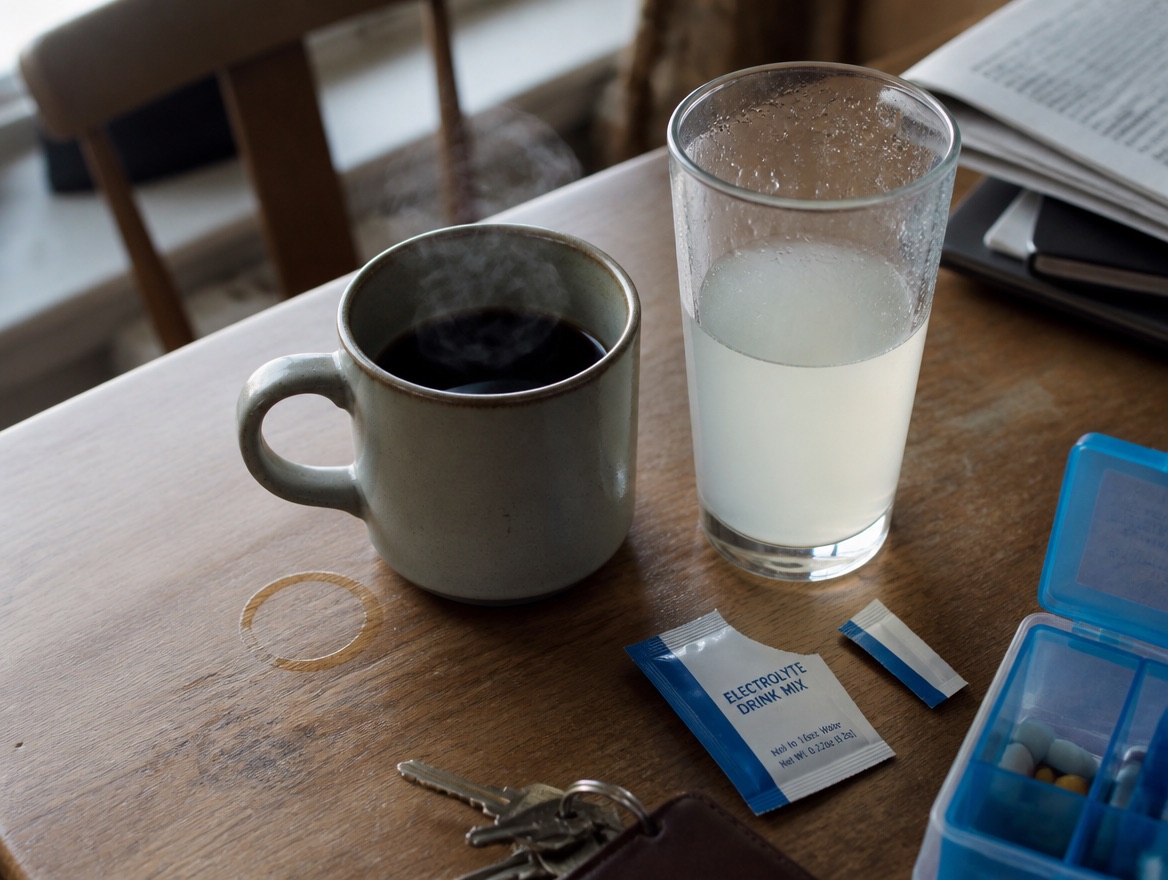
Ask the POTS community about coffee and you’ll get two confident, opposite answers. One camp treats it as a mild poison to avoid entirely; the other can’t function without it and doesn’t see the harm. Both are responding to something real, because caffeine genuinely pulls in two directions at once — and which one a given person notices depends on tolerance, timing, and what they’re comparing it to.
The case for: a transient pressor effect
Caffeine’s best-known trick is blocking adenosine receptors, which is what produces the alertness effect. Less well known is that this same mechanism can cause blood vessels to narrow rather than widen — a mild, short-lived pressor effect that nudges blood pressure up rather than down. For someone with POTS, where the core problem is blood pooling below the heart on standing, a substance that tightens vessels rather than dilating them is at least theoretically working in the helpful direction, not against it.
There’s a real caveat, though, and it mirrors something already well established about caffeine and fluid loss: the effect is strongest in people who don’t consume caffeine regularly, and it fades substantially with habitual use as the body adapts. A once-a-week coffee drinker may notice a real, if brief, lift. A daily drinker’s vessels have largely adjusted, and the pressor effect is a shadow of what it once was. This is one reason the community is so split — people are often describing genuinely different physiological situations depending on how used to caffeine they are.
Coffee’s other case-for argument has nothing to do with blood vessels: it reduces the perceived brain fog that comes with poor cerebral perfusion, which for many people is the more disruptive symptom day to day. That benefit is real even when the pressor effect has faded with tolerance.
The case against: it’s still a stimulant
The counterargument is just as physiological. Caffeine triggers a release of catecholamines — the same class of stimulating hormones already running high in POTS, particularly in the hyperadrenergic subtype. That can mean a heart rate that climbs further on top of a baseline that’s already elevated, along with jitteriness, palpitations, or a “wired but unsteady” feeling that some people find worse than the symptom it was meant to offset.
This is the part of the coffee conversation that doesn’t resolve with tolerance the way the vasomotor effect does. Chronic caffeine use blunts the pressor response fairly reliably, but the stimulant effect on heart rate and adrenaline is more variable — some people build meaningful tolerance to it, others don’t, and either way it can interact with medications. Beta blockers can blunt the heart-rate signal that would otherwise warn you caffeine is pushing too hard; stimulant medications compound directly; and anything affecting blood pressure changes the calculus on the vasomotor side too. None of that is a reason to avoid coffee reflexively — it’s a reason to know your own medication list before experimenting.
The other underrated downside is timing-related rather than dose-related: caffeine late in the day disrupts sleep, and poor sleep is one of the more reliable ways to have a worse POTS day. A coffee that “didn’t seem to cause symptoms” at 4 p.m. may still be the reason the next morning is rough.
| Effect | Direction | What tends to happen with regular use |
|---|---|---|
| Vessel tone (pressor effect) | Tightens vessels, mild BP lift | Fades substantially with daily use |
| Heart rate / catecholamines | Raises HR, can trigger palpitations | Variable — some tolerance, some none |
| Alertness / brain fog | Improves perceived clarity | Holds up better than the pressor effect |
| Fluid loss (diuretic effect) | Mild | Fades with habitual use |
| Sleep, if taken late | Disrupts | Does not meaningfully improve with tolerance |
The timing question
This is where some patients move from “avoid or don’t” to a more specific, tested strategy: using a modest, consistent dose of caffeine early in the day, paired with fluids and sodium, rather than either avoiding it entirely or drinking it on no particular schedule. The reasoning tracks the physiology above — mornings are typically the highest-risk window for orthostatic symptoms after a night of relative fluid redistribution, so a small pressor nudge alongside the fluid and sodium you’d already want on board is, for some people, worth more there than later in the day. The same people often draw a hard line at early-to-mid afternoon, specifically to protect the sleep that caffeine would otherwise cost them that night.
This is a pattern some patients report finding useful for themselves, not an established clinical protocol, and it will not work the same way for someone who has built full tolerance to the pressor effect versus someone who hasn’t. It’s worth treating as a hypothesis to test, not a rule to adopt.
Testing your own response
If you want to figure out where you land, change one variable at a time and give it more than a single day. Keep the dose modest and consistent — a single cup, at a fixed time — for a week, and track how you feel alongside your usual symptom notes, not just on days when something else is already off. Compare a caffeine-free week to a caffeine week if you can tolerate the withdrawal headache that sometimes comes with stopping abruptly. If you use a heart-rate monitor, watching what happens in the hour after your usual cup is more informative than a single spot check.
If you’re on a beta blocker, a stimulant medication, or anything that affects blood pressure, loop your clinician in before you experiment — not because coffee is dangerous, but because those medications change what your body’s signals actually mean, and you want someone who knows the full picture interpreting them with you.
The bottom line
Coffee pulls in two directions in POTS: a transient vessel-tightening effect that can help, and a stimulant effect on heart rate that can hurt, and which one you notice depends heavily on how used to caffeine you already are. There’s no single right answer for the whole community, which is exactly why the debate never resolves. If you want to know where you fall, test one variable at a time, keep the dose modest and consistent, protect your afternoon and evening from it, and talk to your clinician if you’re on medication that changes how your body responds to either sodium or stimulants.